|
|
|
Lithuania, my homeland, land of heroes, Let your sons draw the strength from the past. Let your children follow only the paths of virtue, Working for the good of their land and for all mankind. (An excerpt from the national anthem of Lithuania written by V. Kudirka in 1898) |
||||||
|
|
|
|||||
 |
||||||
 |
There is plenty of excellent detailed historical, statistical, geographical, etc. information about Lithuania on the internet and it is not my intention to attempt to replicate it all here on this website. Instead I will focus on a few key (and in addition some less well-known) facts. |
|||||
 |
█ |
|||||
 |
1. Geography |
|||||
 |
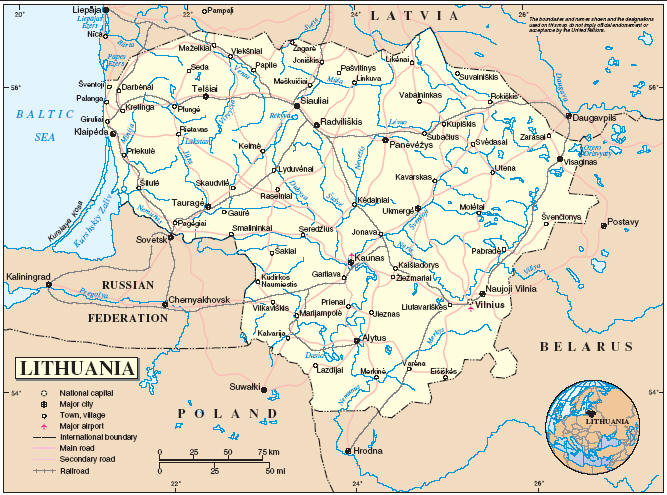
Republic of Lithuania, the largest of the three Baltic states, is situated in Eastern or Central Europe (oh yes, there is a dispute about it), bordering Latvia in the North, Belarus in Southeast and Poland and Russia in the Southwest with the access to the Baltic Sea in the West. The territory of Lithuania is 65.5 thousand square kilometers (e.g. larger than Denmark) populated by 3.4m inhabitants (2006) |
|||||
|
|
||||||
|
|
|
| Last update 07 April 2008 | |
|
|
|
|
2. Historic Origins |
|
|
It is thought that Lithuanian ancestors can be traced to Neolithic hunters and Indo-European tribes that arrived to the current territory from the East and Southeast approximately 2,000 years BC, the most northerly of which were called the Baltic peoples. A recent major genetic study of 1.2m Lithuanians by prof. Kucinskas (2004) shows that current inhabitants are homogeneous, however the genotype was formed from several Baltic tribes. First written record mentioning Lithuania dates back to 1009, however a more centralized duchy (confederation) was formed only in the12th century. In 1240 Grand Duke Mindaugas for the first time united most of Lithuanian lands, was later baptized and crowned as the first king of Lithuania in 1253, which is now considered as the date of Lithuanian statehood inception. Next two centuries witnessed a rapid expansion of the state - as shown in the map below, the the Grand Duchy of Lithuania in 13-15 centuries was spanning the current territories of Belarus, Ukraine and Russia all the way to the Black Sea. |
|

|
|
| Lithuanian language, similarly to other Baltic languages - Latvian and now extinct Prussian, is sometimes considered to be even closer to Proto-Indo-European (a language commonly spoken in Eurasia over 5,000 years ago) than Sanskrit, as manifested by a high degree of inflection (variations of words to indicate their relations with other words and changes in meaning), which is one of the primary reasons why it is among the most difficult languages to learn. | |
| © Linas Ciapas 2004-2008 |